Key takeaways:
- A soapland is a Japanese bathhouse where an attendant washes and massages the client using a body-slide technique. The word is a Japanese coinage (“soap” + “land”), formalised in 1984.
- Thailand does not technically have “soaplands.” The local equivalent is อาบอบนวด (aab-ob-nuat, “bathe-steam-massage”), often translated loosely as soapy massage. Foreign visitors frequently call these venues “soaplands” or “soapies.”
- The two share a common ancestor — both centre on a bath, soap lather, and body-contact massage in a private room — but differ in scale, layout, and selection ritual.
- Bangkok’s aab-ob-nuat venues are large entertainment complexes with the “fishbowl” selection system; Japanese soaplands are usually smaller, single-attendant bathhouses.
A soapland (Japanese: ソープランド, sōpurando) is a type of Japanese commercial bathhouse where an attendant bathes and massages the client, typically using a soap-lather body-slide on a special air mattress. The term is Japanese-made English, and Thailand’s closest counterpart is the older bathing-massage tradition called อาบอบนวด (aab-ob-nuat). The two are cousins, not the same thing.
This guide explains where the word came from, what actually happens inside a soapland, and how the Thai version differs. If you searched “soapland Thailand” expecting a Japanese-style venue, the distinction below matters.
Where the word “soapland” comes from
“Soapland” is a Japanese term, not an English one. The businesses were originally called toruko-buro (“Turkish baths”) from the 1950s. In 1984, after objections from the Turkish embassy and community, the industry adopted a new name through a public contest. The winning entry was “soapland” (Wikipedia).
So the word is a piece of wasei-eigo — English words assembled in Japan for a Japanese concept. It then travelled outward. English-speaking visitors picked it up and started applying it loosely to similar venues across Asia, including Thailand’s aab-ob-nuat parlours. That is why you see “Thai soapland” and “soapies Thailand” in search queries even though no Thai business calls itself a soapland.
What happens inside a Japanese soapland
A traditional soapland session follows a recognisable pattern:
- Selection and check-in. The client picks an attendant from photos or an introduction, then pays a set fee.
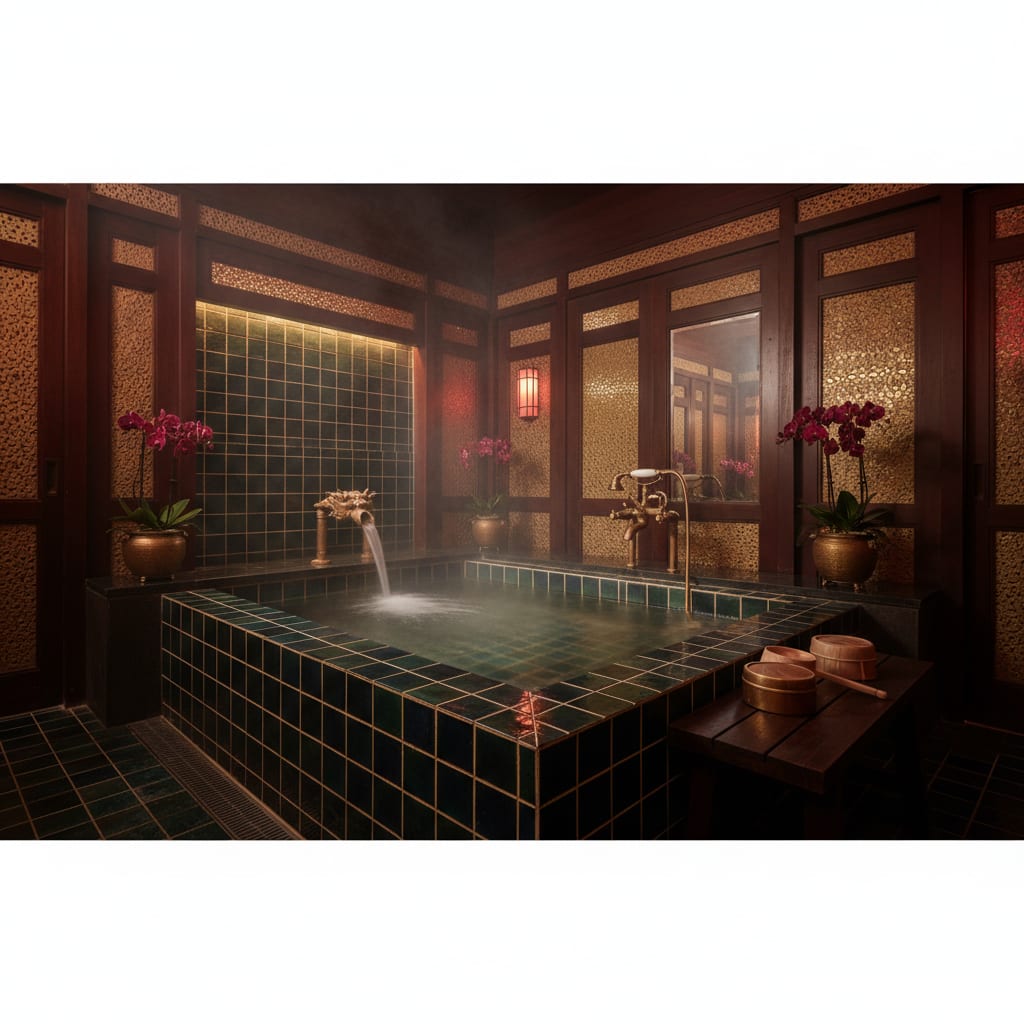
- The bath. The attendant washes the client in a private room with a bathtub and shower.
- The body slide. Using heavy soap lather (and in some venues a special slippery mat or air mattress), the attendant slides their body across the client’s. This is the defining technique.
- Rinse and finish. A final shower and short rest.
Soaplands are concentrated in red-light districts such as Tokyo’s Yoshiwara, Osaka’s Tobita, and Kawasaki. They are usually compact, single-attendant operations rather than the multi-floor complexes you find in Bangkok.
For the underlying technique on its own, see our explainer on what soapy massage is.
The Thai equivalent: aab-ob-nuat (อาบอบนวด)
Thailand’s bathing-massage venues predate the Japanese “soapland” branding and developed on their own track. The Thai term breaks down literally:
- อาบ (aab) = bathe
- อบ (op) = steam / sauna
- นวด (nuat) = massage
These venues are large entertainment complexes — frequently 30 to 100+ private rooms, plus restaurants, bars, and karaoke. The signature element is the fishbowl (ตู้ปลา, dtoo bplaa): a one-way glass window behind which attendants sit wearing numbered tags, so the client chooses by number. There is no direct fishbowl equivalent in a Japanese soapland.
Bangkok’s heartland for this is the Ratchada–Huai Khwang corridor, with newer combined soapy-and-nuru venues clustered around Sukhumvit. Browse current venues in the soapy massage directory.
Soapland vs Thai aab-ob-nuat: how they differ
| Japanese soapland | Thai aab-ob-nuat | |
|---|---|---|
| Local name | ソープランド (sōpurando) | อาบอบนวด (aab-ob-nuat) |
| Origin of the term | Japan, 1984 (renamed from toruko-buro) | Thai, long-standing |
| Venue scale | Small, single-attendant bathhouse | Large entertainment complex (30–100+ rooms) |
| Selection | Photos / personal introduction | Fishbowl (one-way glass, by number) |
| Layout | Bathtub room | Bathtub + waterproof mat + often karaoke, dining |
| Body slide | Soap lather (and slip mats) | Soap lather on a waterproof mattress |
| Where | Yoshiwara, Tobita, Kawasaki | Ratchada–Huai Khwang, Bangkok |
The shared DNA is obvious: a bath, soap, and a body-slide massage in a private room. The differences are scale (Thai venues are far bigger) and the selection ritual (Thailand’s fishbowl). For the body-slide service compared head to head with the Thai term, read soapland vs soapy massage.
Prices: what a Thai “soapland” visit costs
Because true soaplands are a Japanese institution, the practical question for visitors is what a Thai aab-ob-nuat session costs. Verified ranges from our directory (June 2026):
| Tier | Price | Example |
|---|---|---|
| Outer Bangkok | ฿1,500–4,000 | budget venues, fewer tourists |
| Ratchada (traditional) | ฿2,500–5,000+ | fishbowl, karaoke complexes |
| Sukhumvit (combined) | ฿2,400–6,000 | 102 Massage, French-owned, multilingual |
| Premium suite | ฿6,900–40,000 | top-tier penthouse packages |
Prices are all-inclusive and fixed by menu. See the full city-by-city breakdown in our Thailand massage price guide.
Frequently asked questions
What does soapland mean? Soapland is a Japanese term (“soap” + “land”) for a commercial bathhouse where an attendant washes and gives a soap-lather body-slide massage. It was adopted in 1984 to replace the earlier name toruko-buro (“Turkish bath”).
Is there a soapland in Thailand? Not under that name. Thailand’s equivalent is อาบอบนวด (aab-ob-nuat), usually translated as soapy massage. Foreign visitors often call these venues “soaplands” or “soapies,” but no Thai business uses the Japanese term.
What is the difference between a soapland and a Thai soapy massage venue? They share the bath-and-body-slide concept. Japanese soaplands are small, single-attendant bathhouses; Thai venues are large complexes with a “fishbowl” selection window and often karaoke and dining. See our soapland vs soapy massage comparison.
What is the fishbowl? The fishbowl (ตู้ปลา) is a one-way glass window unique to Thai aab-ob-nuat venues. Attendants sit behind it with numbered tags and the client selects by number. We cover it in detail in our fishbowl massage explainer.
How much does a Thai soapy massage cost? From ฿1,500 at outer Bangkok venues to ฿2,500–5,000 at traditional Ratchada complexes, up to ฿40,000 for premium penthouse suites. All prices verified June 2026.
Is it legal? Licensed entertainment venues in Thailand operate under the Entertainment Places Act B.E. 2509 (1966). The venues in our directory are licensed businesses. See our legal guide for the framework.
Your next step
If you came here for the Thai experience, browse the soapy massage directory to compare venues, prices, and locations.
New to the topic? Start with What is Soapy Massage in Thailand? Then read soapland vs soapy massage and nuru vs soapy massage to tell the services apart.
Last researched: June 2026. Prices and details verified against our directory. Found something outdated? Let us know.